the terms are those of a company financing from strength, and the reaction is larger than the terms justify. A zero coupon, a 47.5% conversion premium and a capped call to $1,049.94 mean Axon pays nothing for five years and dilutes only above $652, or above $1,050 after the cap [1]. The value removed on Tuesday was roughly four times the proceeds. That gap is the signature of convertible-arbitrage hedging, where buyers of the notes short the stock on pricing day, layered on a market that had priced Axon for self-funded growth. Which of those dominates is what the five-session window will show.
Axon: A Zero-Coupon Convert Cost the Stock Four Times What It Raised
1. The state
At the September 15 close AXON was $442.08, -9.8% on the day on 2.8 million shares, in the memory's state "down/below/off/stuck/effort/weak/crowd_in": a sharp break below reference levels on heavy effort with weak momentum and crowded participation [9][10]. Tuesday's move is therefore inside the state being scored. The pre-market print at 11:30 UTC on September 16 was $445.12, +0.7%, an.
2. What's new
On September 15 at 11:20 ET Axon filed an 8-K and a preliminary prospectus supplement for a proposed offering of convertible senior notes due 2031, and the shares fell through the session [2][3][7].
3. What that does to the state
The company's second-quarter letter, published August 5, is the baseline the market was working from: revenue of $904 million, up 35%, a tenth consecutive quarter above 30% growth; annual recurring revenue up 39% to $1.6 billion with 126%.
| Vs the market, in points | Low | Middle | High | Share up |
|---|---|---|---|---|
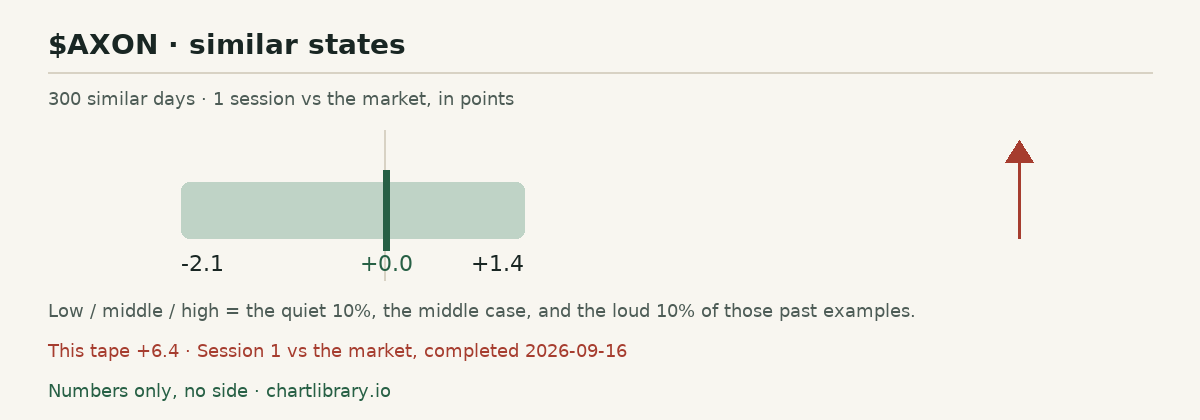
| 1 session | -2.1 | +0.0 | +1.4 | 51% |
| 5 sessions | -3.6 | +0.3 | +4.4 | 58% |
| 10 sessions | -4.3 | +0.2 | +5.1 | 54% |
4. Same state, or a new one
Left yesterday's range
Session 1 vs the market: +6.4. Prior-state 1-session range: -2.1 / +0.0 / +1.4.
When we look again
Session 1: the completed September 16 session, written up after the close (Federal Reserve decision at 14:00 ET is a confounder). Session 5: September 22. Session 10: September 29. Company: settlement of the notes on or about September 18; exercise of the over-allotment option; the third-quarter report in early November. The issuer's press-release index was not machine-readable by our scanner at check time, which is a coverage gap for issuer statements this morning. The issuer's press-release index and presentations page were not machine-readable by our scanner at the check time; issuer statements that morning beyond the cited filings are a coverage gap.
Other reading, tape, and sources
The other reading
The case for the market's reaction is that a company with $598 million of cash, $1.73 billion of debt and a quarter's net income of $29 million is choosing to raise a billion dollars rather than fund growth from operations, and that the prospectus offers no specific use beyond general corporate purposes [3][5]. If the money is for acquisitions at prices set by the current AI-era enthusiasm, the market is right to discount it. The case against is the pricing itself: a 47.5% premium and a 137.5% cap are terms a company gets when investors want the equity option, and a zero coupon on a billion dollars is a cheaper source of funds than the free cash flow it preserves. The drop, on that view, is mechanical and will fade with settlement.
What would change this
Our view is wrong if the five-session window does not recover a meaningful part of Tuesday's drop and the next disclosure names a use of proceeds that implies lower returns than the core business, such as a large acquisition or a further raise. The market's reaction is wrong if the stock recovers most of the drop by September 22 and the notes settle without further supply.
The tape
At the September 15 close AXON was $442.08, -9.8% on the day on 2.8 million shares, in the memory's state "down/below/off/stuck/effort/weak/crowd_in": a sharp break below reference levels on heavy effort with weak momentum and crowded participation [9][10]. Tuesday's move is therefore inside the state being scored. The pre-market print at 11:30 UTC on September 16 was $445.12, +0.7%, an indication rather than a completed session [8]. Attention was moderate: AXON ranked tenth on the Yahoo trending list and did not appear on the Stocktwits list captured at 07:15 ET [11].
What was filed
On September 15 at 11:20 ET Axon filed an 8-K and a preliminary prospectus supplement for a proposed offering of convertible senior notes due 2031, and the shares fell through the session [2][3][7]. The pricing term sheet, accepted at 06:02 ET on September 16, sets the terms: $1.0 billion principal with a $150 million over-allotment option, no regular interest, maturity September 15, 2031, an initial conversion rate of 1.5336 shares per $1,000, a conversion price of about $652.06 (a 47.5% premium to the $442.08 pricing-day close), and capped call transactions with a cap price of $1,049.94, a 137.5% premium [1]. Estimated net proceeds are about $986.0 million, or $1,134.3 million with the option, before the cost of the capped calls; settlement is expected September 18 [1]. Date learned: September 15 morning for the offering, overnight for the terms; economic event: the settlement on September 18.
The numbers around the move
The company's second-quarter letter, published August 5, is the baseline the market was working from: revenue of $904 million, up 35%, a tenth consecutive quarter above 30% growth; annual recurring revenue up 39% to $1.6 billion with 126% net revenue retention; Software and Services revenue up 36% to $398 million; full-year revenue growth guidance raised to 32-34% with a 25.5% adjusted EBITDA margin [4]. Cash and equivalents were $598 million at June 30 against $1.73 billion of long-term debt, and net income was $29 million for the quarter [5]. Shares outstanding were 81.2 million on July 31 [5]. On those figures Tuesday's close valued the company at about $35.9 billion and the drop removed about $3.9 billion, against roughly $1.0 billion raised. The notes would add 1.53 million shares if converted at $652, under 2% of the count, and the capped call offsets dilution up to $1,050 [1]. We did not retrieve a dated sell-side consensus. Our reading of the expectation that moved: not the cost of capital, which is close to zero, but the premise that a business generating $1.6 billion of recurring revenue would not need to borrow a billion dollars to fund what it does next; the prospectus lists general corporate purposes, and the letter's growth guidance is unchanged [3][4].
What the stock did
Tuesday's -9.8% on 2.8 million shares is observed and is the event that defines the current state. The completed September 16 session is not yet observed; it will be scored after the close against the memory's 1-session band, with the Federal Reserve decision at 14:00 ET as a confounder, then the 5-session excess return by September 22 and the settlement of the notes on September 18.
Close update, session 1 (September 16, written after the close): AXON closed at $468.42, +6.0% versus the $442.08 close of 2026-09-15, on 2.6 million shares, about 3.1 times the 20-day average; the session's range was $439.51 to $475.99 after a $441.33 open. Against the market (SPY -0.4%), the excess move was +6.4 points. Against the 1-day band from the pre-news analogs (p10 -3.8, median +0.2, p90 +6.8), that is inside the band.
The comparison
The memory's analogs describe states like Tuesday's close, after the drop: 300 analogous states across 221 symbols, with the 5-day excess band -7.1 / +0.9 / +11.9 and up 56% of the time [10]. For a sharp, crowded break, the memory has more often seen partial recovery than continuation, but the band is wide and it is not conditioned on the cause. The mechanism most cited for convert-day drops, hedge selling by arbitrage buyers, is short-lived by construction once the notes settle; that is our reading of the mechanism, not a measured effect in this sample. Among names we have written about, the nearest case is ENVA, where a financing-related announcement removed far more value than the announcement's dollar size; that note's five-session score is due September 21.
Sources
Raw captures: the pricing term sheet saved under daily-trending/2026-09-16/axon/raw/; the state packet, claim and card under daily-trending/memory/2026-09-15/AXON/; quotes from Yahoo one-minute and daily bars at 11:30 UTC; the attention capture at daily-trending/attention/20260916T111501Z/ATTENTION.json. Not accessed: the cost of the capped call transactions (in the final prospectus supplement, not the term sheet); a dated sell-side consensus; X posts. Benzinga pages return HTTP 403 to our fetcher; wire text and URLs came from ChartLibrary's news store.
- [1] Axon free writing prospectus (pricing term sheet), accepted September 16, 2026 06:02 ET: $1.0 billion 0% convertible senior notes due 2031 · Available Sep 16, 2026 · 6:02 am ET
- [2] Axon Form 8-K, September 15, 2026: proposed offering of convertible senior notes · Available Sep 15, 2026 · 11:20 am ET
- [3] Axon preliminary prospectus supplement (424B5), September 15, 2026 · Available Sep 15, 2026 · 11:23 am ET
- [4] Axon second-quarter 2026 shareholder letter, August 5, 2026 (8-K exhibit 99.1) · Available Aug 5, 2026 · 4:12 pm ET
- [5] SEC XBRL company facts, Axon: cash, long-term debt, net income, shares outstanding · Available Sep 16, 2026 · 12:44 pm ET
- [6] Benzinga wire via ChartLibrary news store: Axon prices $1.0B offering of 0% convertible senior notes due 2031 (02:47 ET) · Available Sep 16, 2026 · 2:47 am ET
- [7] Benzinga wire via ChartLibrary news store: Axon shares trading lower after announcing a proposed $1 billion offering (September 15, 07:42 ET) · Available Sep 15, 2026 · 7:42 am ET
- [8] Yahoo Finance AXON chart, one-minute bars including pre-market, September 16, 2026 · Available Sep 16, 2026 · 7:30 am ET
- [9] Yahoo Finance AXON daily bars · Available Sep 16, 2026 · 7:30 am ET
- [10] ChartLibrary state packet, AXON as of the September 15, 2026 close · Available Sep 16, 2026 · 7:40 am ET
- [11] Alphaforge attention capture, September 16, 2026 07:15 ET (Stocktwits and Yahoo trending lists) · Available Sep 16, 2026 · 7:15 am ET
Live situations, scored after the close. Not a buy list.
The daily note is free and stays free. Follow @ChartLibraryio.
Publication history
- Revision 1 · Sep 16, 2026 · 12:49 pm ET · Initial publication
- Revision 2 · Sep 16, 2026 · 4:20 pm ET · Close update, session 1: completed session versus the framing and the analog band