$NVO: the DKK150bn ambition still has to become profitable growth
Graham McCain · Alphaforge Research · Published Sep 21, 2026 · 4:19 pm ET · Revision 2 Scored over 5 trading sessions.
AI summary
Novo Nordisk presented new pipeline evidence and a long-term sales ambition exceeding DKK150 billion by 2035, but its stock fell. The note views this as a revenue target, not near-term financial guidance, and says the stock needs proof that growing patient numbers will lead to profitable growth. The ADR closed Friday at $43.24, down 8.2% from its close on July 31 after a key trial failed.
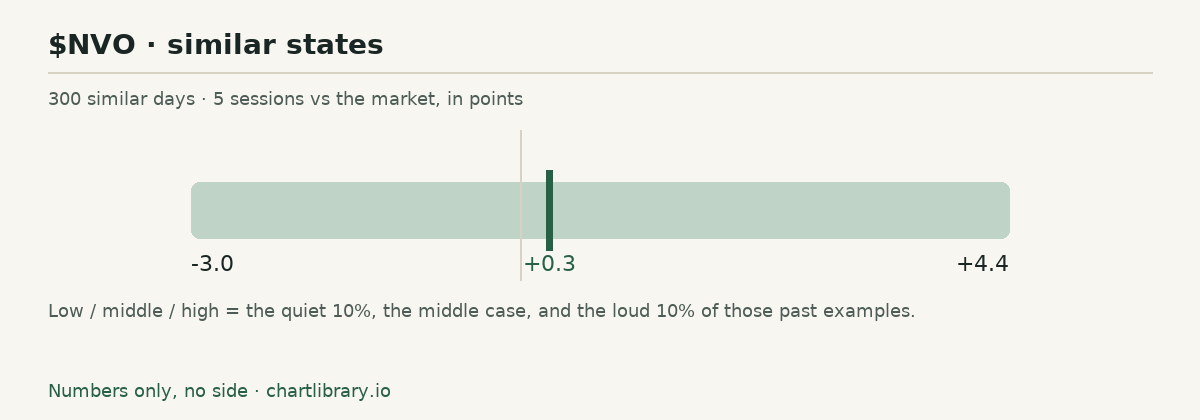
For similar historical states, the five-session excess return range was low -3.0 to high +4.4 percentage points, with a median of +0.3. The strongest other reading is that expanding patient access might not improve earnings if prices fall. The next checkpoint is the session close on September 21.
Two paragraphs generated from the note. The authored note below is the record. Numbers only, no side.
1. The state
As of the 2026-09-18 close. Session 1 has closed.
Friday's ADR close was $43.24, 32.6% below the January 23 high of $64.16. July 31's 8.8% fall followed the failed ZEUS trial; Friday remained 8.2% below that session's close. Friday volume was 1.07 times its 20-day average.
2. What's new
At 04:00 ET Novo set out its capital-markets ambitions; at 06:24 ET it added CagriSema trial results.
3. What that does to the state
The price response suggests investors still question conversion of patient growth into earnings; that is our inference.
300 similar days · 209 stocks · 238 sessions · 1h band
Vs the market, in points
Low
Middle
High
Share up
1 session
-1.5
-0.0
+1.5
48%
5 sessions
-3.7
+0.1
+3.3
52%
10 sessions
-5.6
+0.3
+5.9
53%
The band is the prior close's neighborhood — what followed similar states as of the cutoff.
4. Same state, or a new one
Left yesterday's range
Session 1 vs the market: -9.5. Prior-state 1-session range: -1.5 / -0.0 / +1.5.
NVO closed at $39.82, -7.9% versus the $43.24 close of 2026-09-18, on 46.6 million shares, about 4.7 times the 20-day average; the session's range was $39.54 to $41.17 after a $41.05 open. Against the market (SPY +1.6%), the excess move was -9.5 points.
This cautious reading weakens if subsequent results show rising patient reach converting into sustained adjusted revenue growth without margin erosion.
Session 1: -9.5 vs band -1.5/-0.0/+1.5, left yesterday's range. Session 5: -11.5 vs band -3.7/+0.1/+3.3, left yesterday's range. Session 10: -14.7 vs band -5.6/+0.3/+5.9, left yesterday's range. Scorecard
When we look again
Session 1: September 21 close; session 5: September 25; session 10: October 2. Recheck the remaining Capital Markets Day materials, EASD September 28-October 2, Q3 results November 4 and the company-expected CagriSema FDA decision in Q4 2026.
The July 31 ZEUS trial failed to reduce major cardiovascular events, and the ADR fell 8.8% that session. By Friday it was $43.24, below July 31's $47.08. The question hanging over the stock is whether new products can replace growth investors used to expect from semaglutide.
Today's ambition is more than DKK150 billion of risk-adjusted pipeline sales in 2035. That is a revenue ambition, not present value, earnings or financial guidance. The nearer ambition is peer-like revenue growth through 2030 with a broadly stable adjusted operating margin. There is no numerical growth rate in the highlights release.
Novo's US presentation shows first-half adjusted sales down 4% at constant exchange rates while describing strong GLP-1 volume growth. Patient reach can expand while pricing consumes the benefit. Sandoz's September 18 Canadian generic approval makes that competition tangible; Sandoz expects no material 2026 contribution. Our reading is that the stock needs evidence of profitable growth before a distant pipeline ambition can repair confidence.
CagriSema's new phase 3 results strengthen the scientific case. The diabetes comparison used 5 mg tirzepatide; it does not establish superiority across all doses. Approval and commercial returns are still ahead. The test is whether better treatments produce durable revenue and cash after access discounts, manufacturing and development spending. A large patient market alone cannot settle that arithmetic.
Other reading, tape, and sources
The other reading
An expanding oral franchise and successful launches could sustain margins despite lower prices. CagriSema is additional pipeline evidence, while the August report already raised the 2026 adjusted growth outlook to flat through a 6% decline. Last week's Orbis partnership adds discovery options, while TransCon rights revert to Ascendis; neither establishes near-term sales.
What would change this
This cautious reading weakens if subsequent results show rising patient reach converting into sustained adjusted revenue growth without margin erosion.
The tape
Friday's ADR close was $43.24, 32.6% below the January 23 high of $64.16. July 31's 8.8% fall followed the failed ZEUS trial; Friday remained 8.2% below that session's close. Friday volume was 1.07 times its 20-day average. At 09:18 ET Monday, matching one-minute premarket bars showed NVO at $41.10 (-4.9% from Friday) and SPY +0.6%. These are premarket indications, not a completed session.
What was filed
At 04:00 ET Novo set out its capital-markets ambitions; at 06:24 ET it added CagriSema trial results. The event is still underway. Today's 08:37 ET buyback update reports purchases under the existing programme, not a new authorisation.
The numbers around the move
The price response suggests investors still question conversion of patient growth into earnings; that is our inference. New trial evidence may change that judgment, but Friday's 1h-state five-session excess range remains -3.0 to +4.4 points, with a +0.3 median. It does not measure today's new information.
What the stock did
Not yet observed as a completed session. The September 21 regular close will show whether the move stayed within or left Friday's prior-state one-session excess range of -1.5 to +1.5 percentage points versus SPY.
Close update, session 1 (September 21, written after the close): NVO closed at $39.82, -7.9% versus the $43.24 close of 2026-09-18, on 46.6 million shares, about 4.7 times the 20-day average; the session's range was $39.54 to $41.17 after a $41.05 open. Against the market (SPY +1.6%), the excess move was -9.5 points. Against the 1-day range of what followed similar states as of the prior close (p10 -1.5, median -0.0, p90 +1.5), this session left that neighborhood (below the quiet tail). An abnormal follow-through for that state — look at what changed — not a miss by the memory.
The comparison
The 1h-scale memory uses 300 analogous states across 201 symbols, measured at Friday's close. It compares state and chart shape, not necessarily the same industry or catalyst. Historical ranges are not forecasts and imply no side.
Sources
Reviewed the July ZEUS and August results filings, current SEC submissions, September issuer releases, selected sections of the available Capital Markets Day strategy and therapy-area materials, US operations slides, the issuer calendar, current market reporting, daily bars and the September 18 state packet. The event remains in progress; the full webcast and later finance session have not been reviewed. The corporate news archive did not expose its release list, so the issuer-distributed GlobeNewswire index was checked directly. Trial figures are company-reported topline efficacy-estimand results, not a review of patient-level data. No dated contributor-level consensus or current valuation estimate was verified. Some wire and commentary bodies were inaccessible; corresponding material claims were checked against issuer or partner releases. No conclusion depends on an unread analyst report.